
Erie, PA · Garage Door Service
What Erie's Older Garage Doors Can Still Handle
Erie's housing stock runs from 1938 to 1985, mostly 1960s-70s builds, and our cold winters wear springs and tracks fast. Here's what's actually worth fixing.
- Repairs & new doors
- Springs & openers
- Serving 8 nearby communities
What the Weather Here Does to It
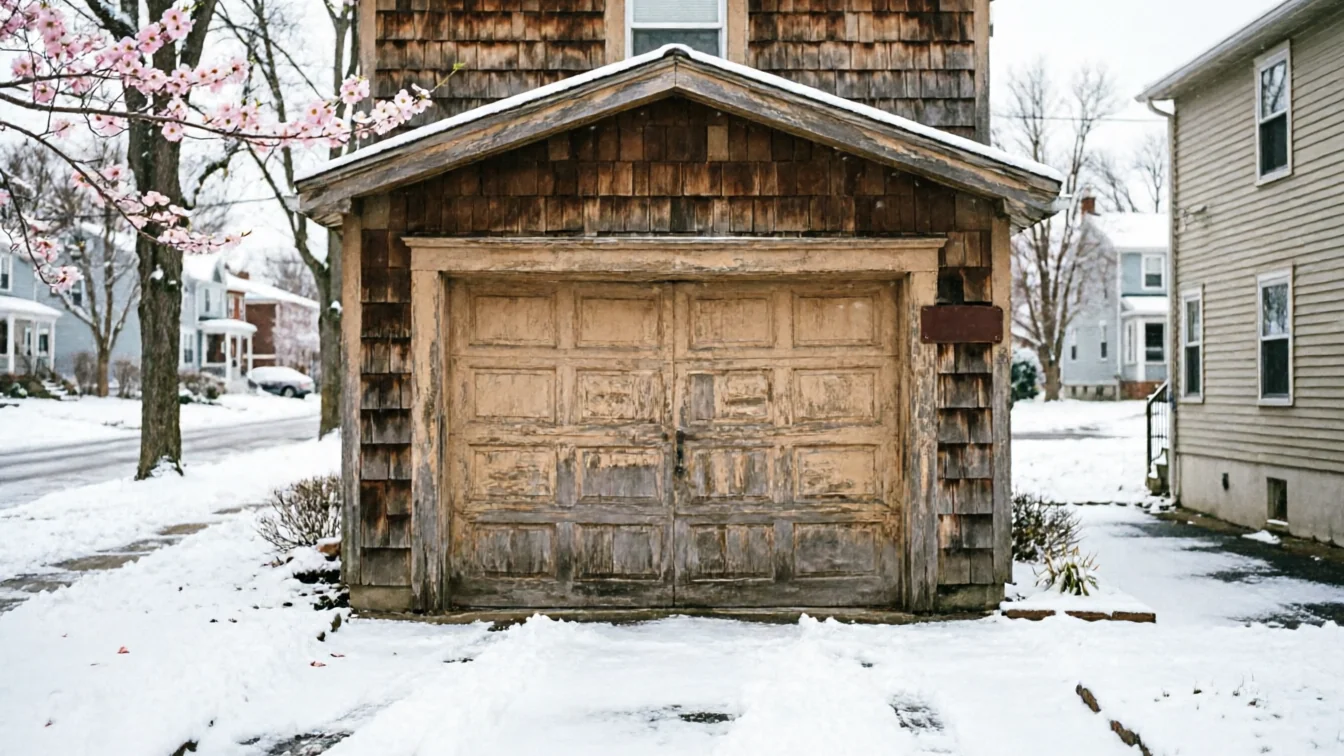
Erie sits in a severe-cold climate band, and that's the detail that decides more repair calls than anything else. Lake-effect snow loads the bottom panel, freeze-thaw cycles work rust into bottom brackets, and cold grease turns to paste in rollers and hinges that haven't been serviced in years. Most of the doors we're called out to sit on houses built between 1938 and 1985, with the median landing around 1971 - old enough that the original torsion spring was sized for a heavier, uninsulated steel or wood panel, not for the lighter retrofit sections some owners have swapped in since. That mismatch shows up as a door that lifts unevenly or an opener that strains in January but seems fine in July. Across the 14 areas we cover - Lawrence Park, Northwest Harborcreek, McKean, Fairview, and the rest - the bulk of the housing stock dates to the 1960s and 70s, which means a lot of these doors have seen fifty-plus winters of expansion and contraction on the same track bolts. That's not a defect. It's just what severe cold does to steel over five decades, and it's the reason a tune-up here does more good than it would somewhere with a milder winter.
When Waiting Is Fine
Age by itself isn't a reason to call. A door built in the 1960s or 70s, when panels were often heavier-gauge steel than what's sold today, can keep running for years past when a newer, thinner door would have quit. If the door travels evenly, the spring isn't visibly stretched or gapped, and the noise is a dry squeak rather than a grinding or popping sound, that's a lubrication and adjustment job, not a replacement decision. Faded paint, small surface dents, and a worn bottom seal are cosmetic - they cost you curb appeal, not safety. Weatherstripping that's gone stiff in the cold is a cheap fix on its own and doesn't mean anything else is wrong. We'll say plainly: we don't push a homeowner to replace a door that's original to a house built in that 1938-1985 window just because of its age. Plenty of those doors were built solid, and with 9,545 owner-occupied houses across this service area, most of them original installs, a lot of what we see is still mechanically sound once the hardware gets attention. Waiting makes sense until the door starts telling you something different - uneven travel, a hard stop, or a spring that looks stretched.
What Is Going On
The common failure on a door from this housing stock is a torsion spring that's simply worn out its cycle count - thirty, forty, fifty years of lifting the same weight twice a day adds up, even on well-built steel. On houses from the earlier end of that 1938-1985 range, you'll sometimes find extension springs without containment cables, which was standard before later code updates required them - that's worth flagging and fixing regardless of what else is going on. Original panels from the 1960s-70s often used thin or no foam insulation, so the door is heavier and less efficient than it looks, which stresses hardware that's already decades old. Rollers that started as steel or nylon on a track installed when the house was built have usually worn an uneven groove by now, which is why the door seems to hop or catch at the same spot every time. Here's the honest limitation: parts for doors that old are sometimes discontinued, and matching an exact original panel or spring size can mean a longer wait than a same-day fix. When that happens, we'll tell you straight instead of forcing a part that doesn't fit right.
When to Call Someone
Call when the door won't stay open on its own, when you see a frayed cable or a spring with a visible gap in the coil, or when the opener strains and reverses before the door seats. Those aren't wait-and-see problems - a broken torsion spring on a door this old can drop fast, and worn cable under tension is a real hazard. At a median household income of $71,578 across this area, most owners we talk to are weighing a repair in the low hundreds against a full replacement running well over a thousand, and that's a real decision, not an easy one. We'll tell you honestly which side of that line your door falls on. If the frame is square, the track is straight, and it's just hardware that's finally given out after decades of Erie winters, fixing it is usually the right call. If the panel's racked, the track is bent beyond adjustment, or the door is fighting the opener every time it moves, that's a different conversation, and we'll have it with you before any work starts.
Frequently asked questions
Is my garage door too old to repair just because it's from the 1960s or 70s?
Not on its own. A lot of the doors in houses built across Erie's 1938-1985 stock used heavier steel than what's common now, and they can run fine for decades with routine spring and roller service. Age alone isn't the deciding factor - how the door is actually traveling and whether the hardware is intact matters more.
Why does my door act worse in winter than summer?
Erie's severe-cold climate thickens old grease, contracts steel tracks, and puts extra load on a spring that may already be near the end of its cycle life. A door that's borderline in July often shows its hand in January, which is why winter is when most of these original-era doors finally get a service call.
Should I replace or repair an original door from the 1960s or 70s?
It depends on what's actually failing. A worn spring, dry rollers, or a bent track are usually worth fixing. A racked panel, a frame that's no longer square, or hardware fighting the opener on every cycle usually isn't. Given a median income of $71,578 in the area, most owners want that distinction made clearly before they spend.
Related garage door services in Erie
More garage door guides
Book garage door service in Erie
Call now or request a quote - tell us what the door is doing and where you are.